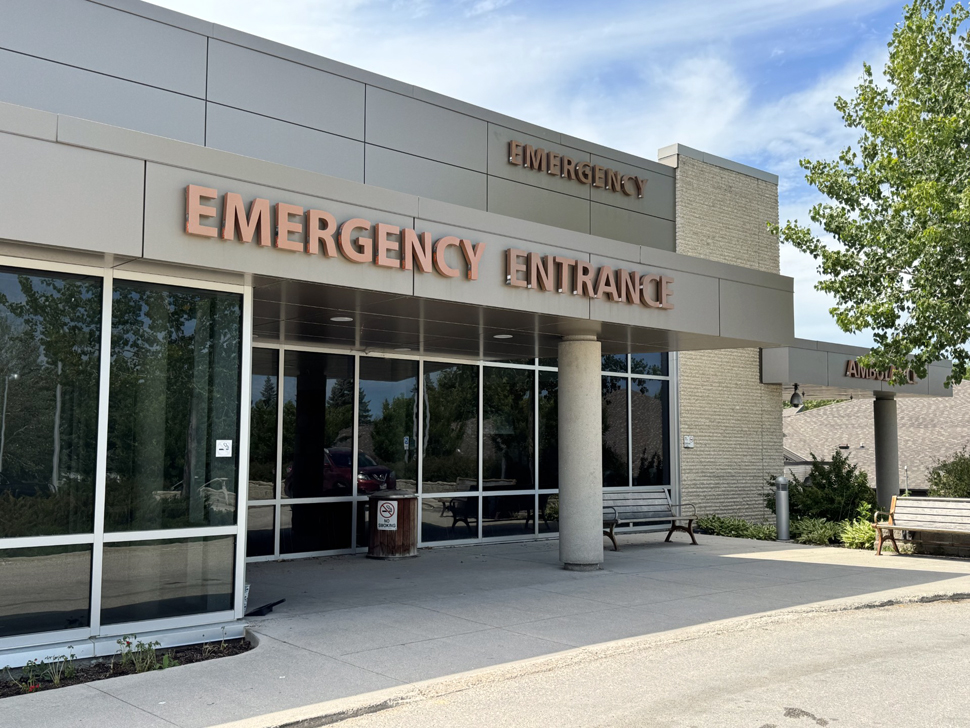
A group of nurses from Bethesda Regional Health Centre in Steinbach is urging our Premier and Health Minister to help improve safety within their Emergency Department. The 40 nurses who have attached their names to the letter come from the hospital's Emergency Department.
Darlene Jackson is President of the Manitoba Nurses Union. She explains that these nurses have been advocating with their employer for a very long time to have a second triage nurse stationed in Bethesda's Emergency Department.
Patients are assigned a number when triaged
Jackson says a triage nurse follows the Canadian Triage and Acuity Scale (CTAS). Each patient is assessed and assigned a number on the triage scale. Jackson says if a patient is assigned a number 1, they are emergent and need to be seen immediately. For someone assigned a number 5, they could probably wait to see their doctor in a day.
Based on the number assignment, Jackson says the triage nurse knows how often a patient needs to be reassessed while waiting to be seen. With wait times sometimes hitting 12 to 15 hours, Jackson says patients need to be reassessed frequently to ensure their condition remains stable and they are not declining.
With only one triage nurse, reassessments are not done as frequently
However, Jackson says the 40 nurses at Bethesda's ER are saying that with only one triage nurse at the hospital, they are so busy triaging patients that they do not have time to get out on the floor and reassess patients.
"So, they are not meeting their Canadian triage standards; they know that," says Jackson. "They don't believe they are meeting their standards of care under the College of Registered Nurses of Manitoba, and this is a big concern because it is a patient safety issue."
Jackson says the deaths of some patients in ERs in Manitoba can be attributed to the fact that their condition declined in between the periods of reassessment.
According to Jackson, the whole point of reassessing a patient is to see which direction their health is trending. If a patient assigned a number 3 suddenly becomes a number 1, they need to be dealt with immediately.
"These nurses have been asking for a second triage nurse to help them with the reassessment in their department," she says.
Second triage nurse has proven beneficial
Jackson explains that there was recently a pilot project, and nurses found it extremely helpful to have this second triage nurse in the department. However, that pilot project has ended, and Jackson says the ER nurses at Bethesda have still heard nothing about getting a second triage nurse.
"The employer is basically saying they do not have the funds to provide that nurse, and nurses are saying you are putting our patients at risk, and you are putting our careers at risk also," notes Jackson.
According to Jackson, adding only one triage nurse would be enough to help solve the problem. She says in their last collective agreement, they negotiated a memo to develop nurse/patient ratios for Manitoba. These nurse/patient ratios are almost like a mathematical equation which says that if you are dealing with this acuity of patients, this is how many patients a nurse can safely manage. Based on that, Jackson says two triage nurses are needed at Bethesda, with one of those being for peak times. However, she says this message went out to the Health Minister in December, and they are still waiting for a response.
"It has been eight months, and we have heard nothing from the Minister of Health," says Jackson. "Nurse/patient ratios would make a massive difference in the Bethesda ER, as would it in many of our ERs across this province."
This is a matter of safety, not reducing wait times
Jackson says having a second triage nurse in the Emergency Department at Bethesda would not reduce wait times, but rather it would help ensure that those who are waiting are safe. She notes that wait times do not begin in the Emergency Department, but rather that is where they end. Jackson explains that many patients are taking up beds who are waiting for home care service, or community service, or for an occupational therapy assessment.
"I've discussed this with the Minister of Health on a couple of occasions and have said, we need to bolster those community services, get those people out into their homes where they want to be, supported by home care, and free up those beds," she says. "That will look after wait times in our Emergency Departments.
Response has been mostly silent
Meanwhile, Jackson says the letter from the 40 nurses at Bethesda has generated a response from the regional health authority. She says the region has questioned whether a particular issue sparked the need for this letter. Jackson says the union has noted that the nurses have been advocating for this for a very long time, and it reached a point where nothing was happening. And as for government, Jackson says there has been no response.
Jackson says though she does not know how many nurses are part of the team at Bethesda Emergency Department, she thinks the 40 nurses make up close to 100 per cent of the team.
The letter was sent to Manitoba Premier Wab Kinew, Health Minister Uzoma Asagwara. Southern Health Interim CEO Dana Human, and Southern Health Board Chair Adam Monteith.














 Thu, Aug 6, 10:00 AM


 Full-time, Hourly, Labour, Manufacturing
 Featured