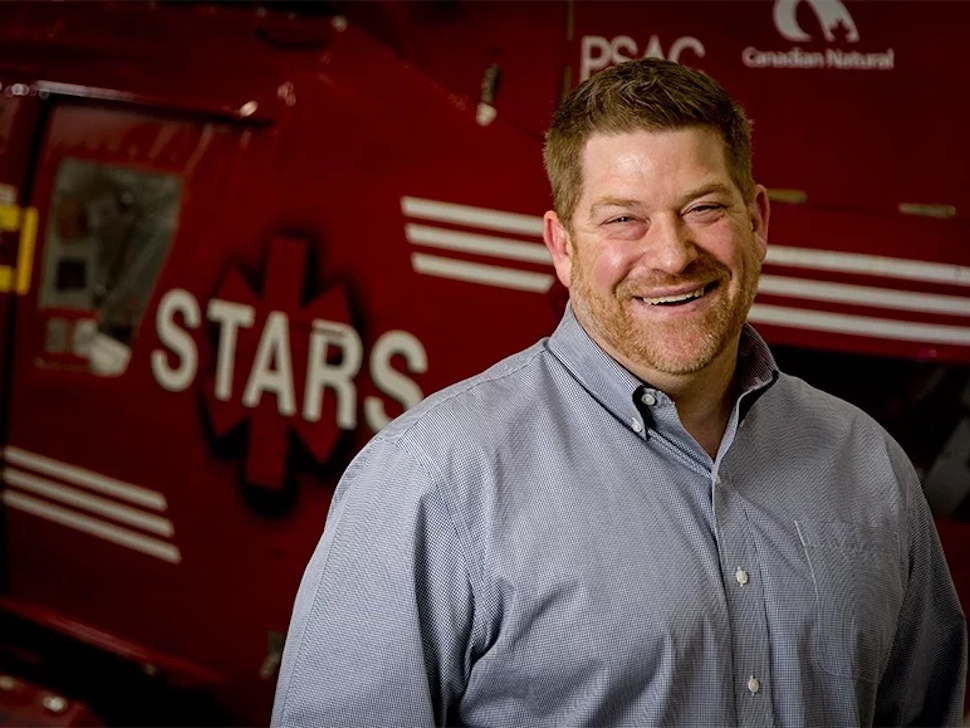
During a routine day of farm work, Chad Rogers found himself in a life-threatening situation, severely injured in a rural location, where his only hope was raising his cell phone as high as he could to secure help.
Later, he would learn the extent of his injuries: a shattered pelvis, a torn ACL, a cracked vertebra, and significant internal bleeding.
His situation and its aftermath were further complicated by his rural setting, which was far from the specialized care he needed.
In that uncertainty, a STARS air ambulance was ready to swoop in to provide the best hope in the worst-case scenario — even in what seemed like an unreachable location.
Today (April 7) marks the start of the Critical Care on the Air Radiothon, presented by BHP and Parrish & Heimbecker, which relies on community support to help make stories like Rogers’ possible.
Over two 12-hour broadcasts today and tomorrow, voices of hope and rescue will come together to raise funds so STARS can continue delivering innovative care where and when it matters most.
The devastating weight of 907 kg
Rogers’ rural accident centres around a baler and a tractor’s weak emergency brake.
“I knew the emergency brake on the tractor was poor, so I parked it heading away from me, and I was opening up a fence,” he said.
“I heard the e-brake click off, and I actually ran after the tractor, and I got to the stairs — and then it rolled me underneath the tire. The tractor and baler ran over me."
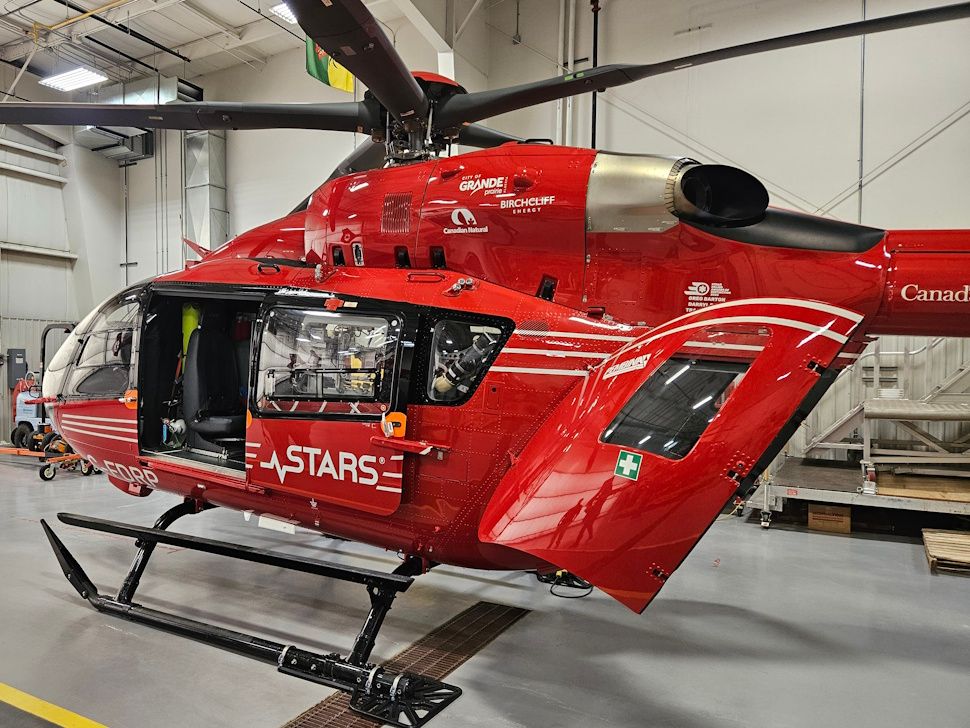 The red STARS air ambulance helicopter has become a symbol of hope in worst-case scenarios.
907 kg of farming equipment crushed Rogers, leaving him struggling to move and grappling to comprehend the extent of what had just happened.
"I was in some sort of trouble," he said.
The face of help when time is of the essence
Although Rogers couldn’t move his feet after the accident, he managed to reach the phone in his pocket.
Holding it up to get a signal, he sent the message that led to STARS coming to his rescue.
Since my accident, I have often asked myself what we did in critical emergency medical situations before we had STARS. The only answer I can come up with is that people died, or did not get a chance at the recovery that I had.
-Chad Rogers on the service that came to his aid after a farming accident. To donate to STARS now, visit the Critical Care on the Air website.
One of the highly trained crew members who responded to the call was Darren Entner, whose face is one of Rogers’ most vivid memories of the day — a sign that help had arrived, even as time remained critical.
“Chad was in a bad way,” said Entner.
“He had some broken bones, his pelvis [was broken], and other injuries, and he was in a ton of pain.”
Creating the best possible outcomes with specialized equipment
As a longtime healthcare professional, Entner understood that pain can be “very detrimental to patients,” so within minutes of arriving at Rogers, the team began treating it.
The STARS air ambulance, equipped with specialized ICU-level medical equipment that the service is continually refining to improve its capabilities, also had a pelvic binder on board to help control Rogers’ internal bleeding.
His condition also called for in-flight blood transfusions to replenish what he lost.
Along with immediate critical care that treated his injuries and eased his pain, Rogers was flown to a major hospital in minutes — a journey that would have taken close to an hour by road.
Assisting in the toughest terrain
His experience is one example of how STARS delivers critical care across the varied terrain of Western Canada.
For Rogers, that meant a rural location. For Trevor Mills, however, it was a mountain highway, where his STARS experience began while he was responding to an emergency himself.
I knew how valuable a resource they were before the accident, but then after going through it, [I understood] the importance and how critical it is, not just for people in rural areas, but people in urban areas as well.
-Trevor Mills, who was rescued by STARS on the side of a mountain highway. To donate to the life-saving service, visit the Critical Care on the Air website.
After seeing an SUV lose control and slide into a steep ravine, Mills acted quickly, working to pull the driver to safety.
In the process, however, the situation turned severe when the vehicle rolled over him, leaving him injured and stranded in the mountains.
As with Rogers, STARS arrived swiftly to treat Mills’ multiple broken bones and fractured vertebra.
Although he lives with lasting injuries, he said he remains grateful for the care he received, which required him to be winched from the ravine.
“It certainly opened my eyes to what STARS does,” he said.
“I knew how valuable a resource they were before the accident, but then after going through it, [I understood] the importance and how critical it is, not just for people in rural areas, but people in urban areas as well.”
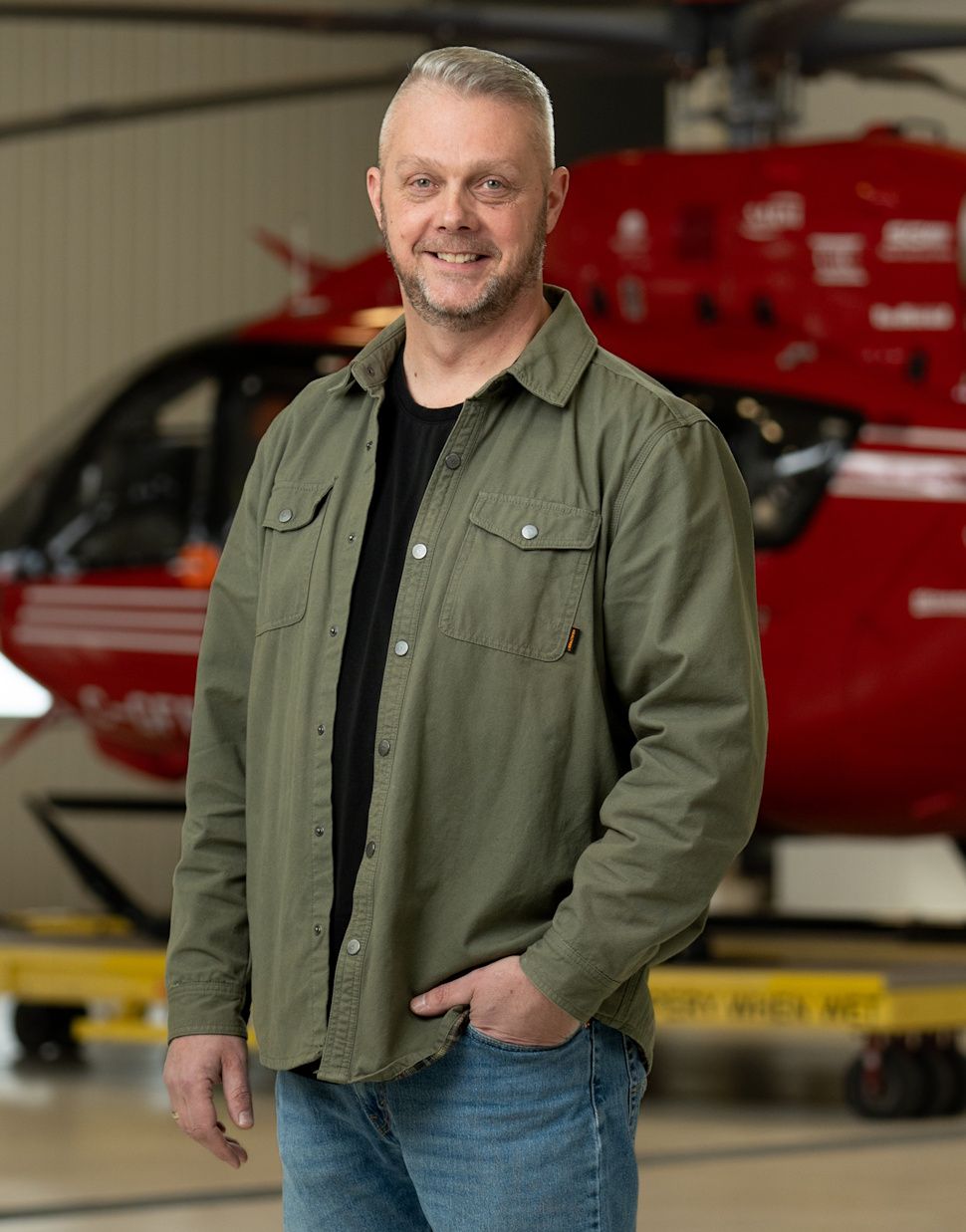 Trevor Mills, who was rescued by STARS, a charity that saves lives thanks to the support of the community.
Supporting life-saving innovation anywhere
Today, Rogers and Mills are proud STARS VIPs, or Very Important Patients, who credit their outcomes not only to the service’s ability to reach even the most remote locations, but also to the state-of-the-art medical equipment it brings to every one of its over 3,000 annual missions.
With the support of the community, STARS continues to reshape what pre-hospital critical care can look like.
Donations to the Critical Care on the Air Radiothon support the research and innovation behind STARS, from automated CPR machines that improve resuscitation in transit to night vision systems, which the service was the first civilian air carrier in Canada to adopt.
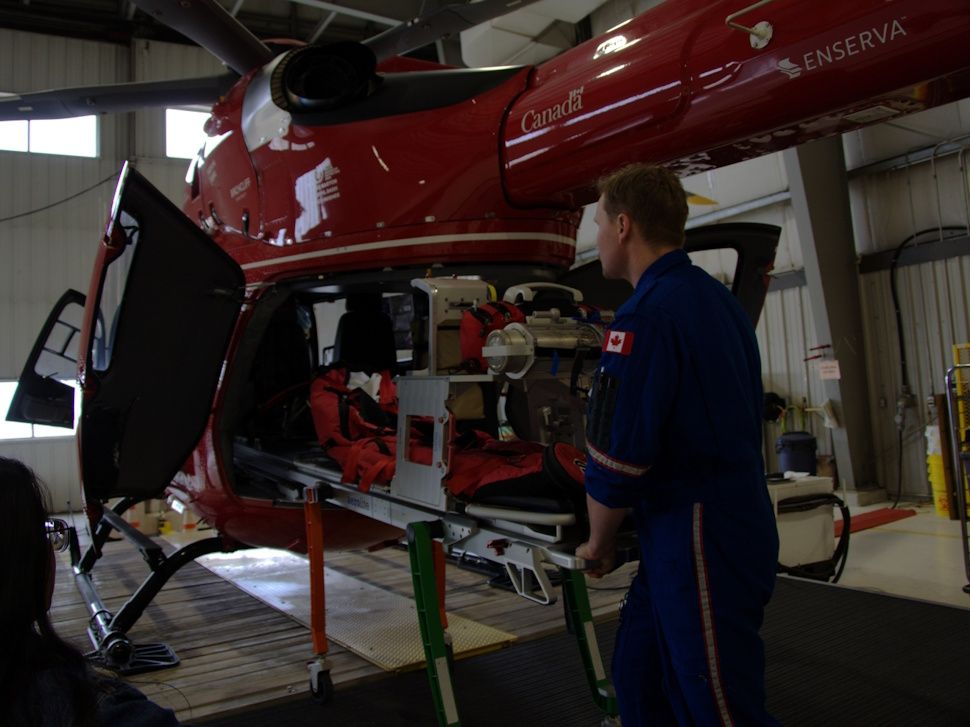 A STARS crew member displays the ICU-level equipment that each of the service's air ambulances carries to provide critical care anywhere.
In 2013, STARS also led the way by becoming the first air medical service in the country to carry blood on its flights — a measure that has created even more possibilities for care when every moment counts.
What did we do before STARS?
For Rogers, whose pre-hospital treatment included several STARS advancements in medical technology, gratitude for the service (and the community that supports it) does not quite capture it.
“Since my accident, I have often asked myself what we did in critical emergency medical situations before we had STARS,” he said.
“The only answer I can come up with is that people died, or did not get a chance at the recovery that I had.”
To help support the next patient in need, visit the Critical Care on the Air website to donate, call 1-877-507-8277, or text “STARS” to the Scotiabank Text-to-Give line at 45678 to contribute $20.
For more stories of rescue against the odds, stream or tune in to the Critical Care on the Air Radiothon presented by BHP and Parrish & Heimbecker in support of STARS on April 7 and 8.










 Tue, Apr 7, 8:30 AM


 Full-time, Permanent, Retail, Sales
 Featured